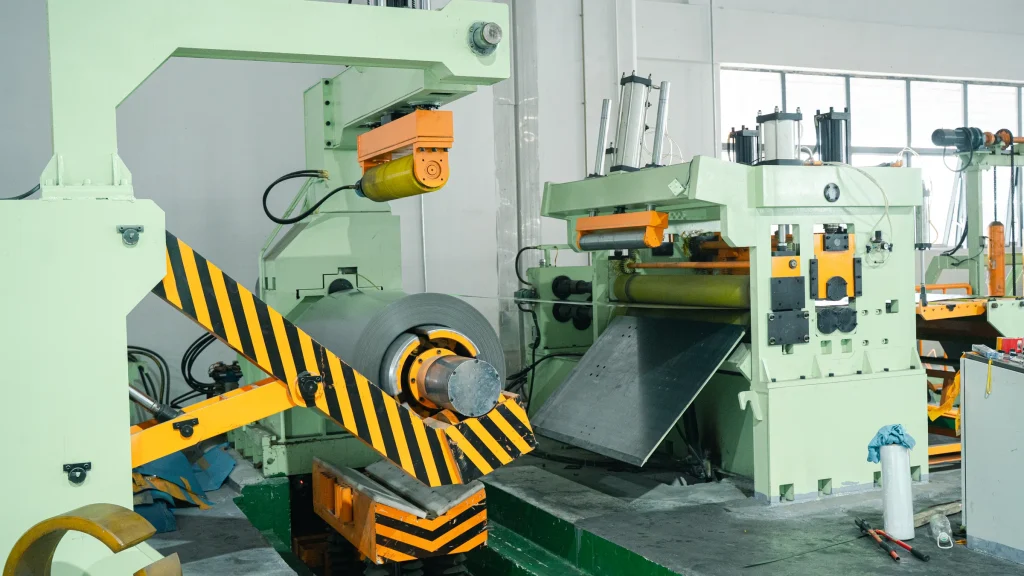
Regular maintenance keeps slitting knives and the complete production line in serviceable condition, reduces avoidable downtime, and supports safe operation. The maintenance system for a RONGXING 1650mm Coil Slitting Line should follow the delivered machine manual and the customer’s approved site procedures.
The original Chinese article presents six management rules rather than a component-by-component service manual. Its main message is that maintenance, inspection, documentation, and supervision must be organized before a failure occurs.
The six original rules are retained below. Their purpose is to improve equipment availability, reduce wear and repair cost, extend service life, and prevent maintenance work from becoming an informal response after production has already stopped.
1. Keep the equipment ready for production
The first rule is to keep the slitting knives and related machinery in good technical condition so that the equipment can be put into operation whenever production requires it.
Strong maintenance reduces failure-related stoppages and helps improve both the integrity rate and utilization rate of the machinery. It also reduces mechanical wear, extends equipment service life, and lowers operating and repair costs.
The original article connects these economic goals directly with safe production. Maintenance is not only a way to keep output running; it is part of the work required to keep the machine in an acceptable operating condition.
This principle applies across the wider coil-processing equipment range: the maintenance plan should match the actual machine, operating load, and production task instead of being copied from unrelated equipment.
2. Put prevention before repair
The second rule is expressed in the original article as “give equal importance to maintenance and repair, with prevention first.” Equipment should receive regular and mandatory maintenance according to the established plan.
Use, maintenance, and repair must be managed as one relationship. The article specifically rejects two common practices: using equipment without maintaining it and repairing equipment only after failure without carrying out routine maintenance.
Preventive work should therefore be arranged before wear or a small abnormal condition becomes an unplanned shutdown. The exact task and interval must come from the applicable machine procedure rather than from a generic article.
The third rule assigns this responsibility to each work team. Every team must complete the required maintenance according to the machinery-maintenance procedure and the defined maintenance category. Work must not be delayed without a valid reason.
If a special situation requires an extension, it must first be approved by the responsible engineer or technical person. The original article adds a clear limit: as a general rule, the extension should not exceed one-half of the specified maintenance interval.
For example, if the approved interval is represented by I, the normal maximum extension described by the source is:
Extension ≤ I / 2
This does not create a new universal RONGXING interval. It preserves the original management rule that any delay must be controlled, approved, and limited.
3. Complete every item and record the result
The fourth rule states that maintenance quality must be guaranteed. Every required item should be completed one by one according to the specified scope and requirements. Required work must not be skipped, omitted, or treated as complete without being performed.
Maintenance items, maintenance quality, and any problems found during the work should be recorded. The record should then be reported to the responsible technical person or engineer in the department.
If the team encounters a problem it cannot solve, the original article instructs it to obtain technical assistance rather than continue by guesswork. For RONGXING equipment, customers can use the appropriate service and support route and provide the machine reference, fault description, operating condition, and available records.
A useful record should make the completed work traceable. The source does not prescribe a particular form, but it clearly requires three types of information:
- Which maintenance items were completed.
- Whether the maintenance quality met the requirement.
- Which problems were discovered and reported.
This documentation allows the next shift, the technical department, and management to understand the actual machine condition instead of relying on memory.
4. Use three checks, one handover, and supervision
The fifth rule requires maintenance personnel and the responsible department to follow “three checks and one handover.” The original article defines these as:
- self-inspection;
- mutual inspection;
- full-time or professional inspection;
- one qualified handover.
Self-inspection means the person or team performing the work checks its own result. Mutual inspection adds a second check by another person or team. Professional inspection provides verification by the designated specialist or responsible function. The equipment or completed work is then handed over only after it is considered qualified under the applicable procedure.
The article also requires teams to keep summarizing maintenance experience and improving maintenance quality. Records should therefore be used not only to prove that work was completed, but also to identify repeated problems and improve later maintenance. Relevant operating and maintenance knowledge can be organized through the RONGXING coil-processing guides.
The sixth rule gives the asset-management department an ongoing supervisory role. It should regularly supervise and inspect the maintenance work performed by each unit.
Maintenance quality should also be checked through scheduled or unscheduled spot inspections. The original management approach includes rewarding good work and applying penalties where maintenance requirements are not met.
Together, the six rules form a closed management process: establish preventive requirements, assign the work, control any delay, complete every item, document problems, inspect the result, hand over qualified equipment, and supervise the system over time.
All maintenance must still follow the delivered machine documentation, the site’s authorization rules, and its hazardous-energy and safety procedures. A management checklist does not authorize work on energized or inadequately isolated machinery.
For a machine-specific maintenance discussion, send the equipment reference, maintenance record, fault description, operating hours, material, and photos through the RONGXING Contact page.
FAQ
Why does the article emphasize preventive maintenance?
Planned maintenance can reduce failure downtime, mechanical wear, repair cost, and safety risk while extending equipment service life.
What does “maintenance and repair are equally important” mean?
Routine maintenance must continue even when repair capability is available. The machine should not be used without maintenance or serviced only after failure.
Can a scheduled maintenance interval be extended?
Only under the approved process. The original rule requires responsible technical approval and normally limits the extension to one-half of the specified interval.
What information must be recorded?
Record the maintenance items, the quality of the completed work, and every problem discovered, then report the result to the responsible technical person.
What are the “three checks and one handover”?
They are self-inspection, mutual inspection, professional inspection, and one qualified handover after the work meets the applicable requirement.
Who supervises maintenance quality?
The original article assigns regular supervision, inspection, and spot checks to the asset-management department or equivalent responsible function.