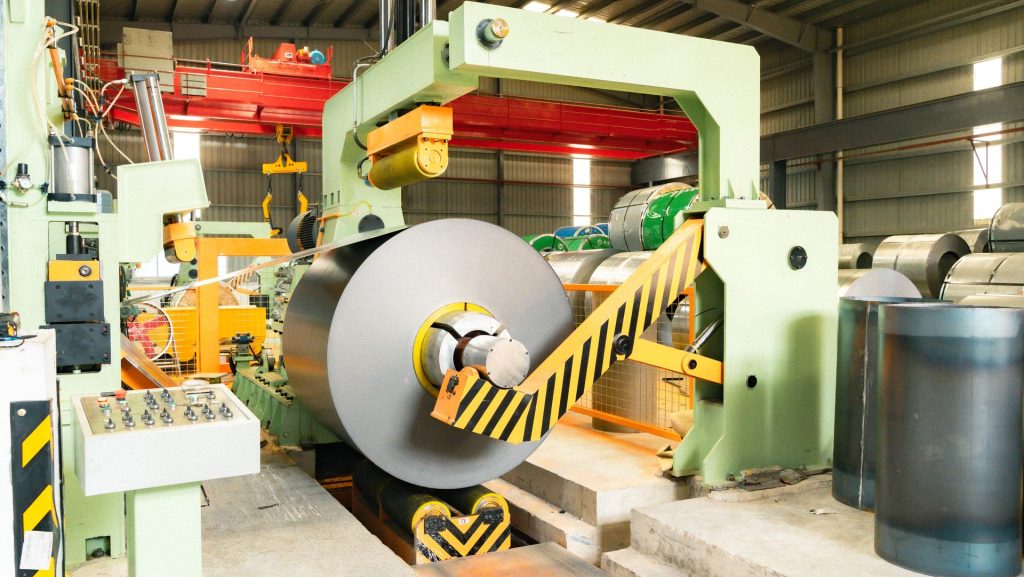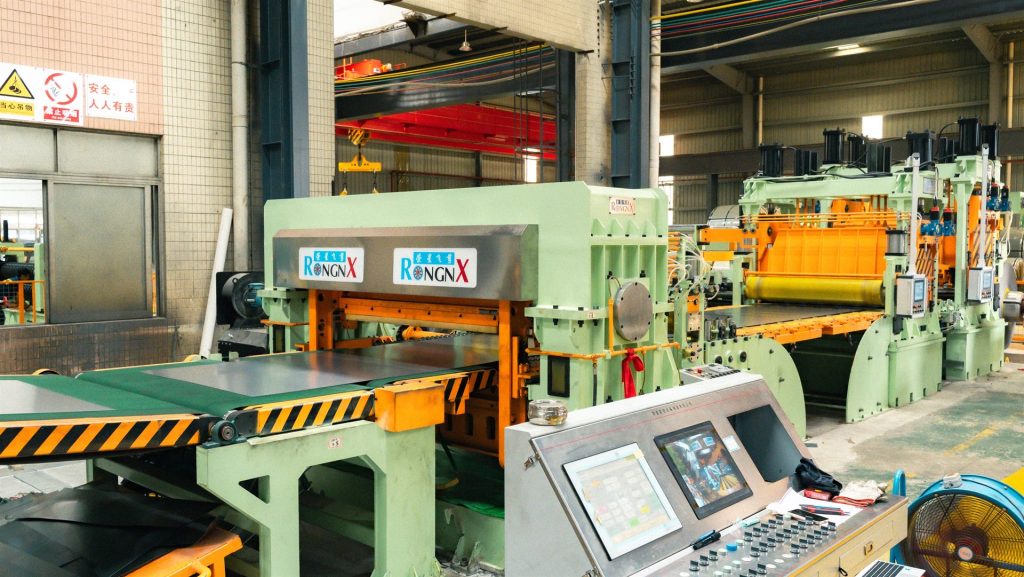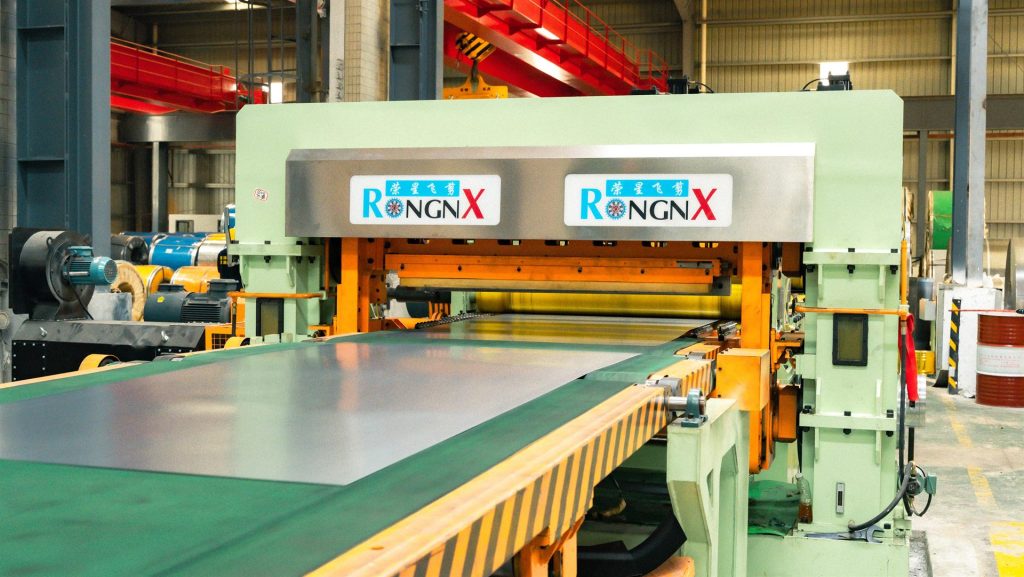
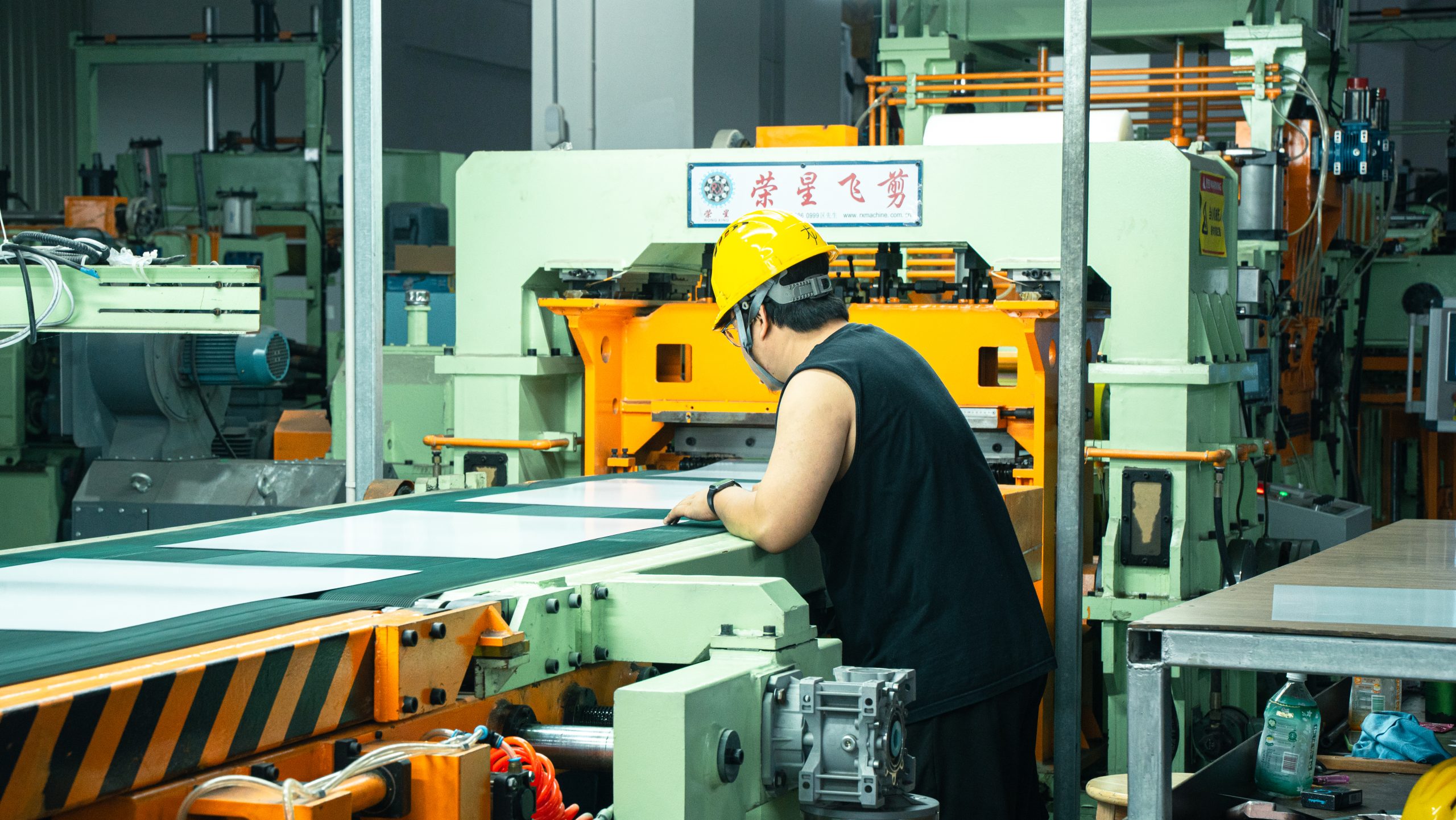
A flying shear cuts sheet to length while the strip continues to move through the line. The control system tracks strip travel, coordinates the shear with the moving material, and sends each finished sheet toward the conveyor and stacker. The strip does not need to stop for every normal cut.
See the complete RONGXING flying shear cut-to-length line range to compare how uncoiling, leveling, measuring, cutting, conveying and stacking are configured as one system.
That is the short answer. In practice, good results depend on much more than the shear itself. Uncoiling, guiding, leveling, length measurement, cutting, conveying, and stacking must work as one process.
What is a flying shear?
A flying shear is the cutting section of a continuous cut-to-length line. Its job is to separate a moving strip into sheets of the required length.
In a stop-shear line, the strip normally slows or stops before the cut. In a flying-shear line, the material keeps moving during the normal cutting cycle. The cutting mechanism follows or synchronizes with the strip long enough to complete the cut, then prepares for the next cycle.
The exact mechanical arrangement can vary between machines. What remains consistent is the control objective: measure the moving strip, reach the correct cutting position, coordinate the cutting motion with line speed, and discharge the sheet without disturbing the next cycle.
The complete coil-to-sheet process
The Flying Shear is one section of a larger production line. A typical process follows these steps.
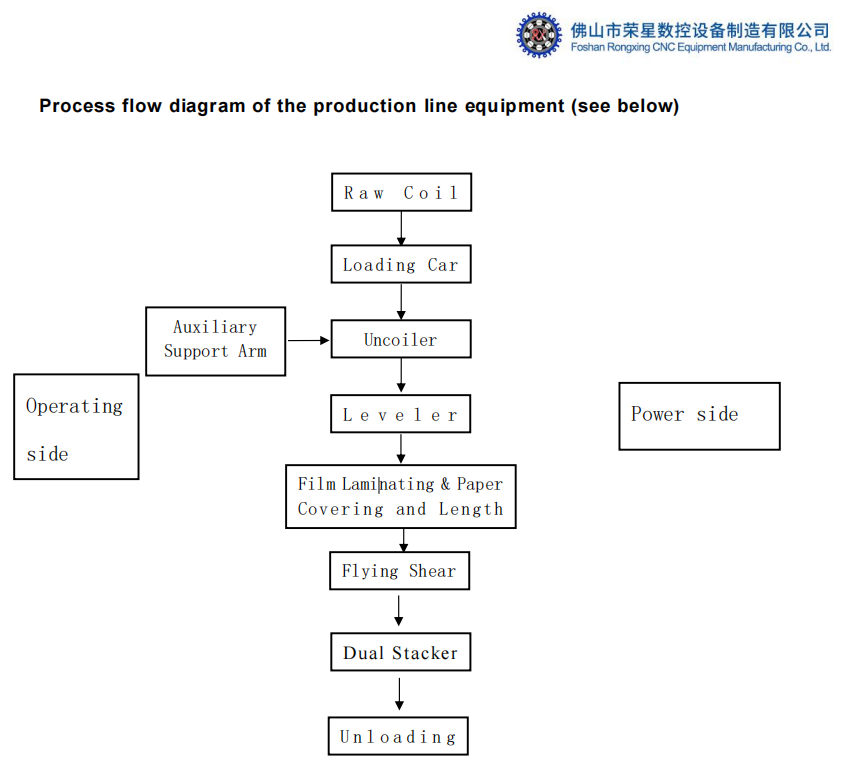
1. Load and position the coil
The incoming coil is placed on a coil car or another loading device and aligned with the uncoiler. Coil weight, inner diameter, outer diameter, width, and material condition must match the equipment selected for the project.
Good alignment at the beginning makes it easier to control the strip through the rest of the line.
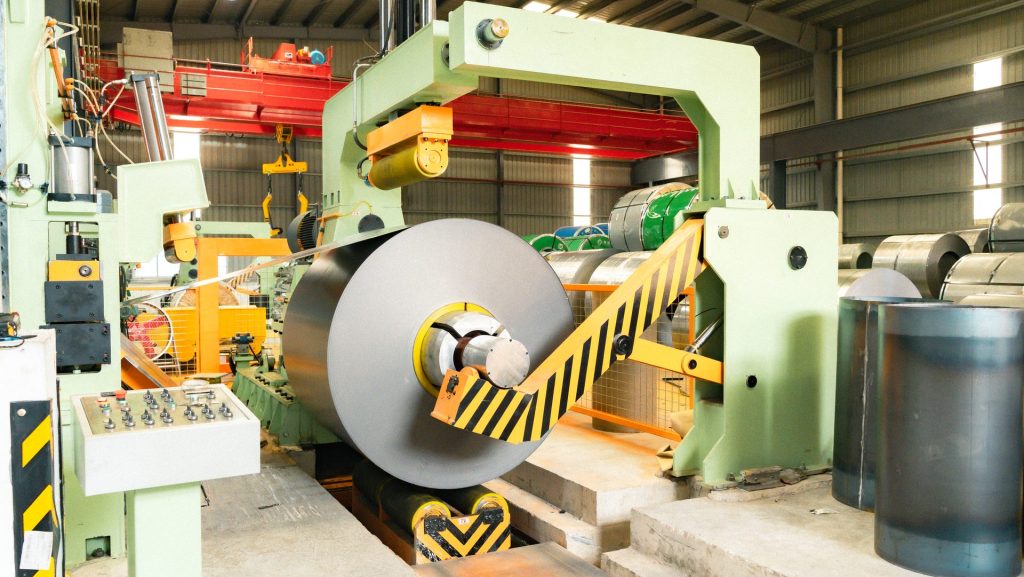
2. Uncoil the strip
The uncoiler supports and expands inside the coil, then pays the strip into the line under controlled conditions.
This section must handle the changing coil diameter while keeping the material stable. Poor coil support or uncontrolled feeding can affect guiding, leveling, measurement, and surface condition further downstream.
3. Guide the material
The entry guide keeps the strip centered before it reaches the leveling and measuring sections.
Guiding is not a cosmetic step. If the strip enters at an angle or moves from side to side, it becomes harder to maintain a stable path through the leveler and shear.
4. Level the strip
The leveler bends the strip through a series of rolls to reduce coil set and prepare it for cutting into flat sheets.
The required leveler depends on the material, thickness, width, strength, incoming coil condition, and finished-sheet requirement. A setup suitable for one material cannot automatically be treated as suitable for every other grade or thickness.
Leveling also affects what happens after cutting. A sheet that still carries excessive curve or internal stress can be more difficult to convey and stack consistently.
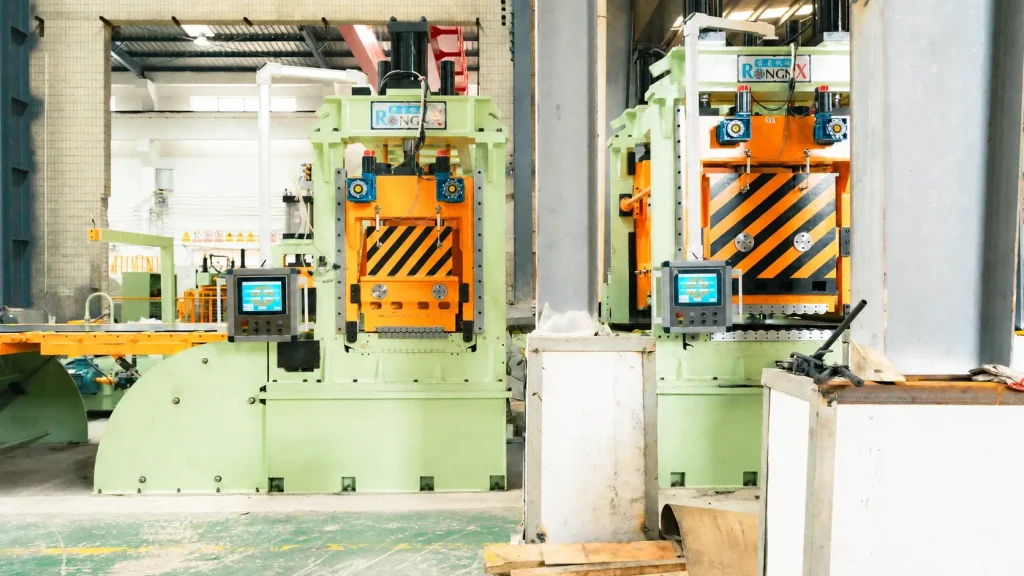
5. Measure the target length
The measuring system tracks how far the strip has travelled. An encoder or measuring roll commonly provides movement feedback to the line control system.
The controller compares the measured travel with the target sheet length stored in the production setting. It then determines when the next cutting cycle must begin.
Measurement is not isolated from the material. Roll contact, strip tension, slip, acceleration, and mechanical condition can all affect the relationship between measured travel and the finished sheet.
6. Synchronize the shear with the strip
Before cutting, the shear motion must be coordinated with the moving strip. The control system uses the measured strip speed and position to time this movement.
During the cutting window, the cutting mechanism reaches the required relationship with the strip so the cut can be completed without stopping normal material flow. After the cut, the mechanism returns or moves into position for the next cycle, depending on the machine design.
This is the central idea behind the flying shear working principle: the cut is made as part of a controlled moving process, not as a separate stop-and-start action.
7. Complete the cut
The blade passes through the strip and separates the finished sheet from the material behind it.
Cut quality depends on the complete condition of the cutting system. Blade condition, blade clearance, mechanical alignment, material properties, and synchronization all matter. A controller cannot compensate for every mechanical or tooling problem.
The correct setup therefore requires both control work and mechanical inspection.
8. Convey the finished sheet
After cutting, the sheet must leave the shear area at a controlled rate. The conveyor creates safe separation between sheets and moves them toward the selected stacking position.
Conveyor timing is important. If the downstream section cannot receive the sheet cleanly, the line may need to slow down even when the shear itself can cycle faster.
9. Stack the sheets
The stacker collects the finished sheets for removal or further processing.
A project may use a single stacking position or a dual-stacking arrangement. The right choice depends on finished-sheet size, output target, bundle change requirements, material surface, handling method, and available space.
The stacker should be considered during line selection, not added as an afterthought. A fast cutting section provides little benefit if finished sheets cannot be received and removed reliably.
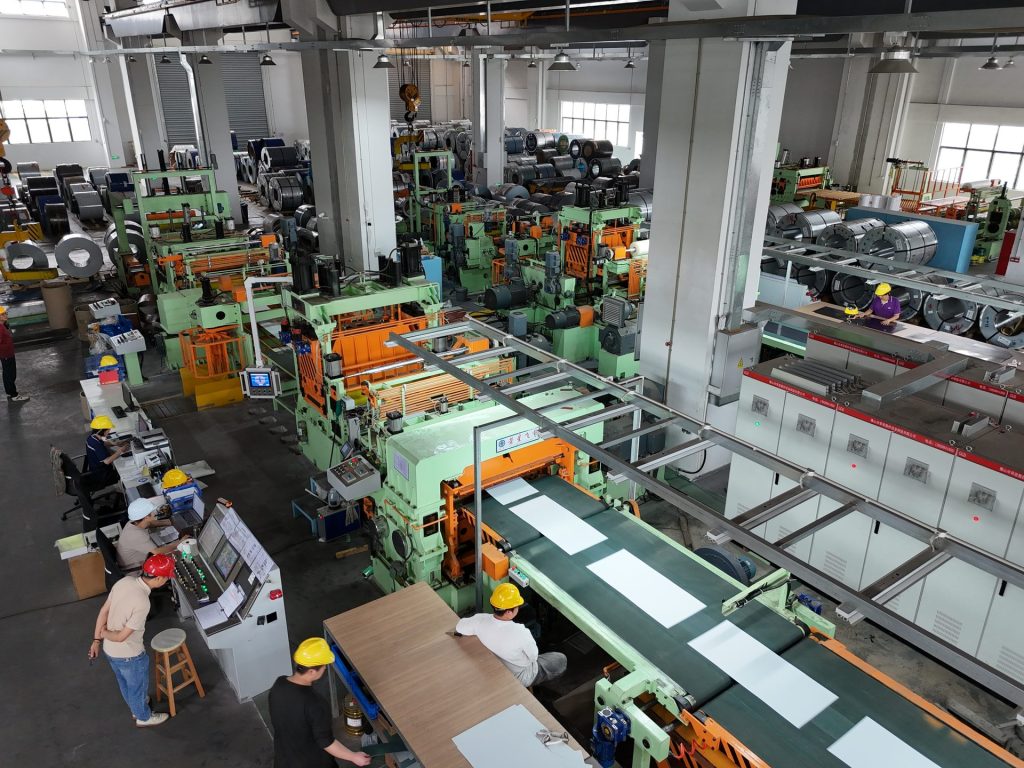
Why cut while the strip is moving?
The main advantage is not a marketing phrase such as “advanced high-speed technology.” It comes from avoiding a repeated stop-and-restart cycle during normal cutting.
When the strip can keep moving:
- the line can maintain a steadier material flow;
- the uncoiling, leveling, measuring, cutting, and conveying sections can operate as a coordinated process;
- repeated deceleration and acceleration of the strip can be reduced;
- downstream handling can be planned around a more consistent production rhythm.
This does not mean that every Flying Shear line should run at the highest possible speed. The practical line speed must suit the material, sheet length, leveling requirement, cutting cycle, conveyor, stacker, safety system, and required finished quality.
The useful question is not “What is the maximum speed?” by itself. It is “What speed can the complete line maintain for this material and finished product?”
What affects cut length and cut quality?
The measuring system and shear control are important, but they are only part of the result.
Stable strip travel
The strip must pass through the measuring section in a controlled way. Slip, inconsistent contact, unstable tension, or sudden movement changes can affect length feedback.
Correct synchronization
The shear motion must match the timing calculated from strip position and speed. If the relationship is wrong, the cutting point or sheet handling can be affected.
Mechanical condition
Backlash, worn components, poor alignment, and inconsistent drive response can reduce repeatability even when the control command is correct.
Blade setup
Blade material, sharpness, clearance, overlap, and alignment must suit the strip being cut. Incorrect blade conditions can contribute to burrs, distortion, or poor cut edges.
Material properties
Material grade, tensile and yield strength, thickness, width, coating, and surface sensitivity influence the required machine configuration and tooling.
For that reason, RONGXING does not recommend selecting a line from width alone. The engineering review must consider the complete incoming coil and finished-sheet requirement.
Flying shear, stop shear, or rotary shear?
No shear type is the best choice for every application.
A Flying Shear is useful when continuous strip movement and coordinated coil-to-sheet production are important. A stop shear may be practical where the production requirement allows the strip to pause for cutting. Rotary and other continuous cutting systems can suit different material ranges, sheet lengths, speeds, and production objectives.
The decision should be based on actual production data, not on the equipment name alone. A more detailed comparison will be covered in the next guide: Flying Shear vs. Rotary Shear vs. Stop Shear: How to Choose the Right CTL Line.
Information to prepare before requesting a line
A useful technical discussion starts with the coil and finished product. Buyers should prepare:
- material type and grade;
- minimum and maximum strip thickness;
- minimum and maximum strip width;
- yield or tensile strength where available;
- coil inner diameter, outer diameter, and maximum weight;
- required finished-sheet lengths;
- required cut-length, diagonal, flatness, and edge conditions;
- target production speed or output;
- surface-protection requirements;
- preferred stacking and bundle-removal method;
- available factory space, power supply, and handling equipment.
These details help determine the uncoiler, guide, leveler, measuring system, shear, conveyor, stacker, drives, controls, and line layout.
You can review the current RONGXING Flying Shear Cut-to-Length Line family or send the project requirements through the Contact page.
Frequently asked questions
Does the strip stop during Flying Shear cutting?
During the normal flying-shear cutting cycle, the strip continues to move. The line can still stop during setup, inspection, alarms, coil changes, or other operating conditions.
How does the line know when to cut?
A measuring device tracks strip travel and sends position or movement feedback to the control system. The controller uses the target sheet length and current line conditions to time the cutting cycle.
Does a Flying Shear guarantee accurate sheets?
No single component guarantees the finished result. Measurement, strip stability, synchronization, mechanical condition, blade setup, leveling, conveying, and stacking all influence production quality.
Can one Flying Shear line process every metal and thickness?
No. The final configuration depends on material grade, tensile strength, coil width, thickness, surface condition, finished-sheet requirement, and production target.
Is a dual stacker always better?
Not always. A dual stacker can help with particular bundle-change or production requirements, but it adds equipment, controls, layout, and handling considerations. The stacker should match the real production process.
What should a buyer send for a quotation?
Send the material and grade, thickness and width range, coil size and weight, finished-sheet lengths, target speed or output, quality requirements, stacking method, and site information.
Discuss your cut-to-length requirement
A Flying Shear line should be configured around the material and finished product, not selected from a model name alone.
Send RONGXING your coil specification, target sheet sizes, output requirement, stacking method, and available space. The engineering team can then identify the questions that must be resolved before a technical proposal is prepared.