
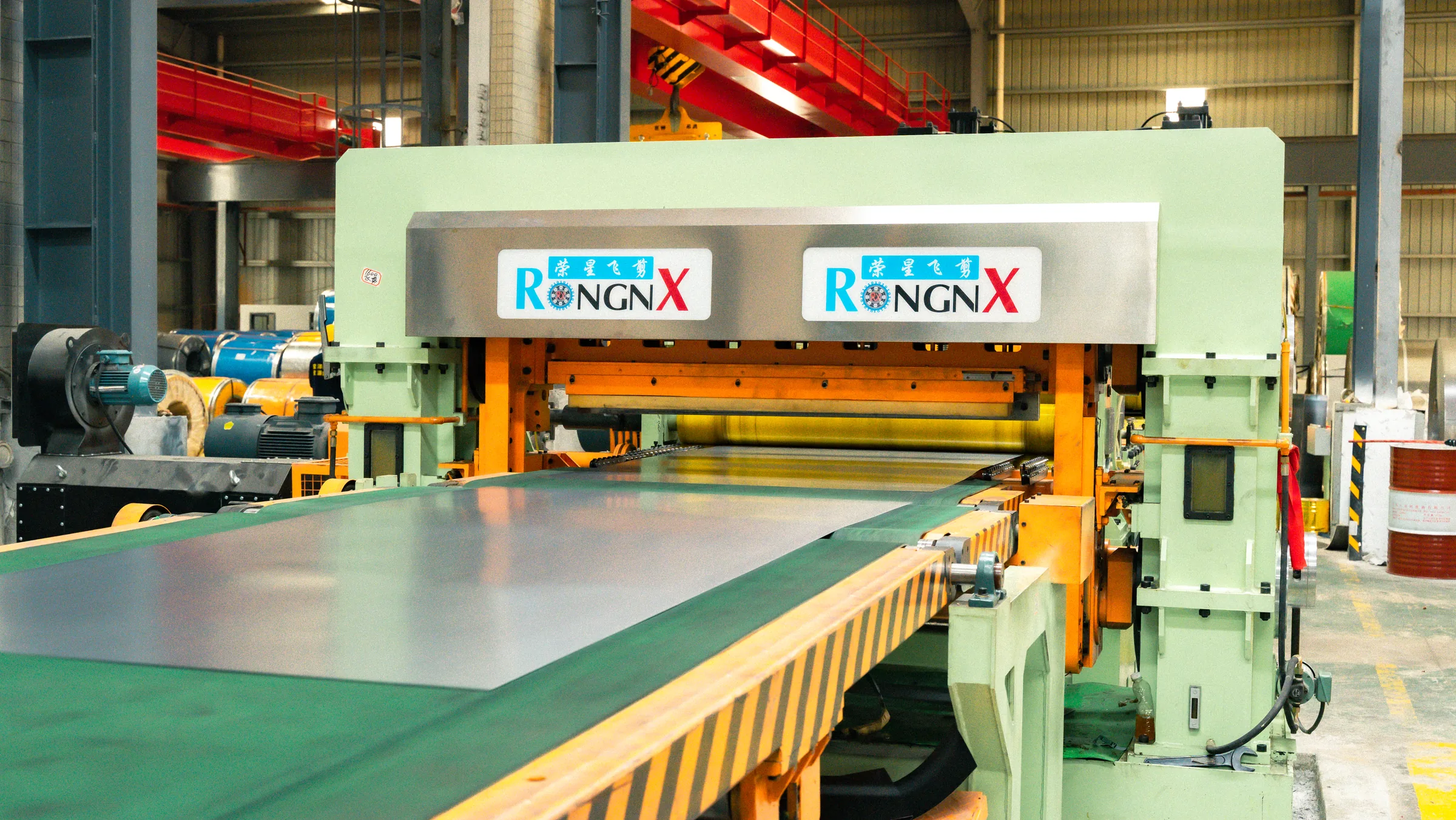
A Flying Shear is not automatically better than a rotary shear or a stop shear. The right choice depends on how the strip must move, what material will be processed, the required sheet lengths, the expected output, and whether the leveler, conveyor, and stacker can support the same production rhythm.
For current model and process options, review the RONGXING Flying Shear Cut-to-Length Lines family page before selecting a shear type.
For most buyers, the useful question is not “Which shear is the fastest?” It is “Which complete cut-to-length line can produce the required sheets consistently from this coil?”
The practical difference between the three systems
A Flying Shear cuts while the strip continues to move. The control system measures strip travel and coordinates the cutting motion with the material during the cutting window. After the sheet is separated, the shear prepares for the next cycle while the rest of the line continues to manage material flow.
This arrangement can reduce repeated stopping and restarting during normal production. It is useful when continuous feeding matters, but it also makes coordination important. Measurement, line speed, shear motion, conveyor timing, and stacking must work together. A fast cutting unit alone does not make a productive line.
A rotary shear also cuts moving material, but the cutting action is produced by a rotating mechanism rather than a shear assembly that follows the strip in the same way as a typical Flying Shear. The term “rotary shear” can describe more than one mechanical arrangement, so buyers should ask the supplier to explain the actual knife path, cutting cycle, and suitable material range.
Rotary cutting can suit continuous production when its mechanical cycle matches the strip, sheet length, and material. The important limitation is that the rotating geometry and cycle must be considered as part of the application. A design that works well for one thickness or length range should not be assumed to suit every other job.
A stop shear uses a different production rhythm. The strip reaches the target length, slows or stops, and a stationary cutting section completes the cut before the material accelerates again. This can be a practical approach when the required output allows a start-stop cycle or when the material and finished-sheet requirement are better handled under stationary cutting conditions.
The repeated acceleration and deceleration must still be controlled. It can affect cycle time, strip stability, measurement, and the way material moves through the leveler. For that reason, a stop-shear line should be evaluated as a complete system rather than dismissed as simply “slow” or accepted as automatically “simple.”
| Selection point | Flying Shear | Rotary Shear | Stop Shear |
|---|---|---|---|
| Strip movement during a normal cut | Continues moving | Continues moving | Slows or stops |
| Cutting action | Cutting motion is synchronized with the strip | Rotating cutting mechanism completes the cycle | Stationary shear cuts after the target feed |
| Main engineering concern | Measurement, motion synchronization, conveying, and stacking must remain coordinated | Rotary geometry and cycle must suit the material and sheet program | Feeding, stopping, cutting, and restarting must remain stable |
| Useful when | Continuous coil-to-sheet flow is important | The rotary design matches the required production range | The production target permits a controlled start-stop cycle |
| What must be confirmed | Material range, speed, length range, cutting method, and downstream capacity | Actual rotary mechanism, tooling, material range, speed, and length limits | Cycle rate, strip control, leveler behavior, and finished-sheet handling |
This table is a starting point, not a specification. The same equipment name can cover different mechanical designs, and the final choice must be checked against the actual coil and finished product.
What actually determines the right choice?
Material information comes first. The supplier needs more than “steel” or “aluminum.” Material grade, yield or tensile strength, minimum and maximum thickness, width range, coating, surface sensitivity, and incoming coil condition all affect the leveler, drives, tooling, shear, and handling method.
Sheet length also changes the decision. A line producing short sheets at a frequent cutting cycle places different demands on the shear, conveyor, and stacker than a line producing longer sheets. Buyers should provide the normal production lengths as well as the minimum and maximum. One unusual order should not be allowed to hide the main production requirement.
Required output must be described in practical terms. A maximum line-speed figure does not explain how often the line must cut, how long a bundle change takes, or whether the stacker can receive the sheets without interruption. It is better to provide the target material, sheet length, sheets per batch, planned operating hours, and expected production rhythm.
Finished-sheet quality matters just as much as cutting speed. The discussion should include cut-length requirement, diagonal or squareness requirement, acceptable edge condition, flatness expectation, and surface protection. These results depend on more than the shear. Strip guiding, leveling, measurement, blade setup, mechanical condition, conveying, and stacking all contribute.
The downstream system can become the real limit. After each cut, the sheet needs enough separation and control to travel safely to the stacker. Thin, light, wide, long, or surface-sensitive sheets may behave differently during conveying and stacking. A single stacker may be suitable for one production plan, while another project may need a different bundle-change or sheet-handling arrangement.
Factory conditions should also be included early. Available floor space, foundation, electrical supply, coil handling, finished-bundle removal, operator access, and the planned line direction can change the layout. Choosing a shear before confirming these conditions can lead to an equipment list that looks complete but does not fit the real workflow.
These factors are connected. For example, choosing continuous cutting to increase output only helps when the leveler can prepare the material, the measuring system can track it, and the conveyor and stacker can receive the sheets at the same pace. If one section repeatedly forces the line to slow or stop, the advantage expected from the cutting method may not appear in production.
Questions buyers should ask before choosing
Ask the supplier to explain the cutting sequence in plain language. Does the strip move during the cut? Which part of the shear moves? How is strip travel measured? How is the cutting cycle coordinated with line speed? A clear answer is more useful than a list of control components.
Ask which part of the proposed range is already covered by the standard design and which part requires a special configuration. The widest coil, thickest material, shortest sheet, and highest output may not occur in the same production order. The supplier should review realistic combinations rather than treating every maximum value as simultaneous.
Ask how the complete line was selected. The proposal should connect the coil data to the uncoiler, guide, leveler, measuring section, shear, conveyor, stacker, drives, controls, and safety arrangement. If the explanation focuses only on the shear, important production limits may still be unresolved.
Ask what will be checked before shipment. The factory acceptance plan should use agreed material or a technically justified test method. It should identify which functions, sheet sizes, cut results, alarms, line sequences, and handling steps will be reviewed. Any performance value in the contract should have a clear test condition.
Finally, compare quotations on the same basis. Check whether coil loading, scrap handling, tooling, safety guards, stacker arrangement, electrical scope, installation, commissioning, training, and spare parts are included. A lower equipment price may simply reflect a different boundary of supply.
RONGXING recommends preparing the following information before a technical discussion:
- material type, grade, strength, coating, and surface condition;
- minimum and maximum thickness and width;
- coil inner diameter, outer diameter, and maximum weight;
- normal, minimum, and maximum sheet lengths;
- target output for the main production programs;
- required cut length, diagonal, flatness, edge, and surface conditions;
- preferred stacking and bundle-removal method;
- available space, power supply, foundation, and handling equipment.
With these details, the shear type can be considered together with the full coil-to-sheet process instead of being selected from a product name.
Frequently asked questions
Is a Flying Shear always faster than a stop shear? Not under every production condition. A Flying Shear avoids stopping the strip during the normal cutting cycle, but actual output still depends on material, sheet length, leveler capacity, cutting cycle, conveyor, stacker, and bundle handling.
Is a rotary shear the same as a Flying Shear? No. Both can cut moving strip, but their mechanical cutting actions are different. Because rotary-shear designs vary, the supplier should explain the actual mechanism and operating range of the proposed machine.
Does thicker material always require a stop shear? That conclusion should not be made from thickness alone. Material strength, width, sheet length, cut quality, tooling, line speed, and the supplier’s verified design range must be reviewed together.
Can the shear type guarantee cut-length accuracy? No. Length measurement, strip stability, synchronization or feed control, mechanical condition, blade setup, and downstream handling all affect the finished result.
Which system is best for short sheets? The answer depends on the required cutting frequency, material, line speed, shear cycle, conveyor separation, and stacking method. Buyers should provide the real short-sheet production program instead of asking for a general rule.
What is the best way to compare two CTL quotations? Use the same material data, sheet program, output target, quality requirements, stacking method, test conditions, and boundary of supply. Then compare how each complete line meets those requirements.
You can review the RONGXING Flying Shear Cut-to-Length Line family and send your coil data, finished-sheet program, and factory conditions through the Contact page. RONGXING can then identify which questions must be resolved before a line configuration is proposed.