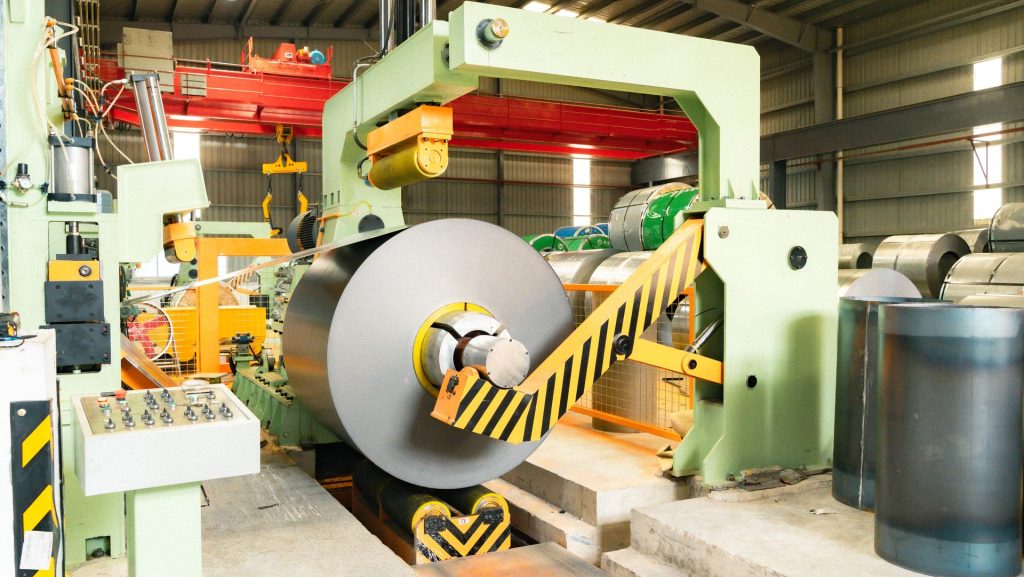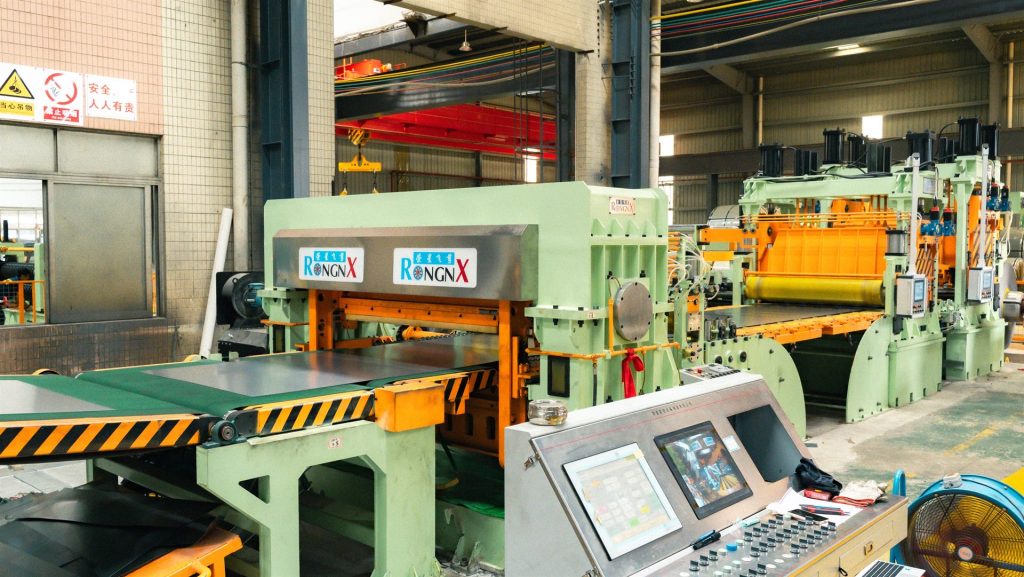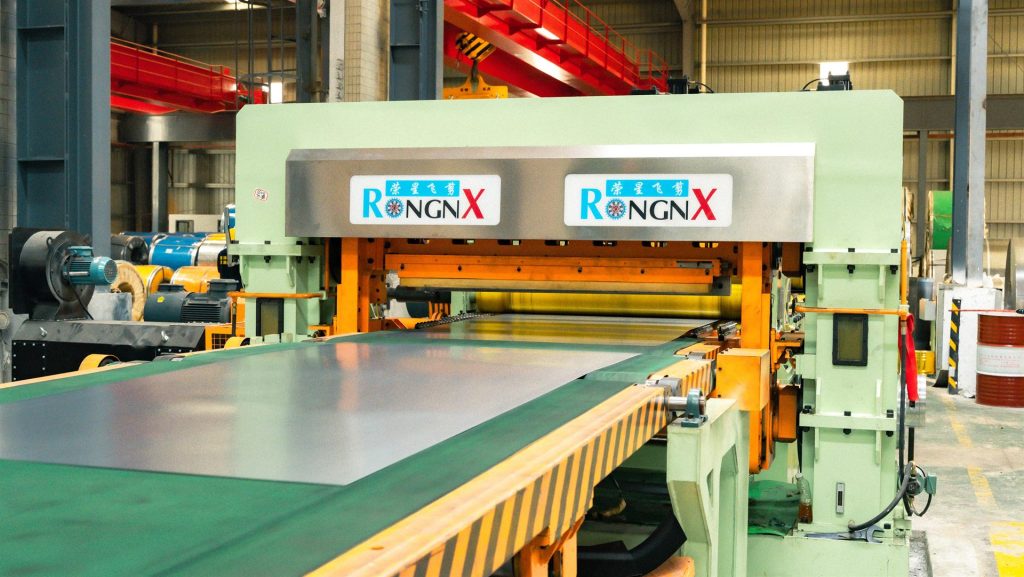
At the center of the RONGXING 1650mm Flying Shear Cut-to-Length Line is a cutting system developed around two core RONGXING components: our self-developed dual-crankshaft Flying Shear head and our own servo motor.
Instead of treating the motor, gearboxes, crankshafts, knives and control response as unrelated parts, RONGXING engineers them as one coordinated cutting system. This approach comes from our combined experience in equipment manufacturing and real steel processing. You can read more about our history, manufacturing operations and in-house R&D on the RONGXING Company page.
A Flying Shear Head Designed Around Its Drive
In a continuous cut-to-length line, the strip keeps moving during the normal cutting cycle. The servo motor drives the cutting mechanism so the knife motion can be coordinated with the moving material at the required cutting point.
The documented head uses two side gearboxes and a dual-crankshaft arrangement. Diaphragm couplings connect the motor, gearboxes and linkage shaft. The gears and crankshafts use 42CrMo, with specified heat treatment and hardened gear-tooth surfaces. The gearboxes are also run in after assembly to improve the working relationship of the gears and backlash before the cutting head enters service.
Because the Flying Shear head and servo motor are developed within the same RONGXING engineering system, the mechanical and drive requirements can be reviewed together. Material, thickness, width, target speed and finished-sheet requirement still determine the final configuration; the motor or cutting head alone cannot guarantee the production result.
Rigid Knife Support and Adjustable Clearance
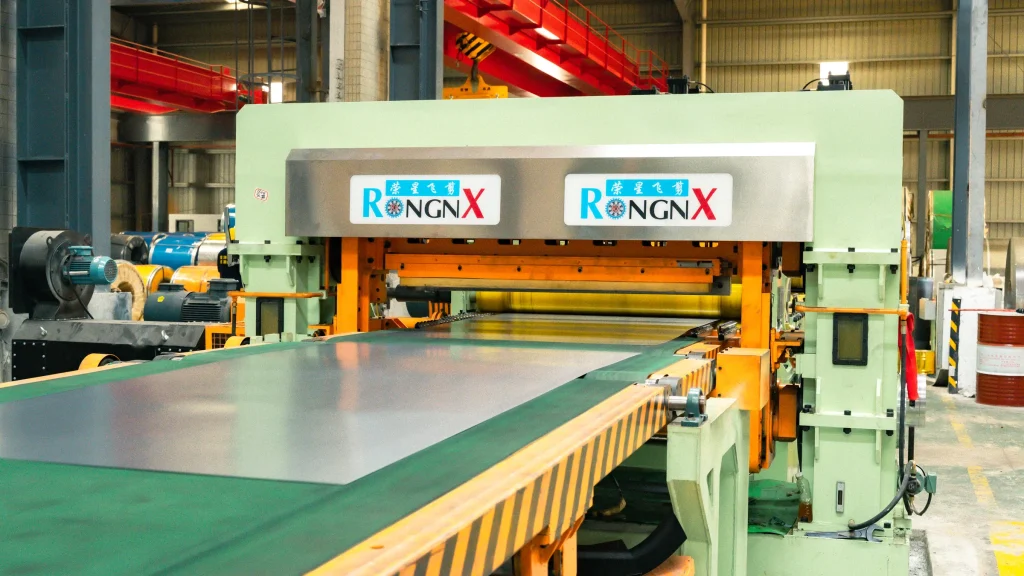
The reference configuration uses 1700 × 75 × 25 mm upper and lower knives made from LD high-speed steel, with a specified hardness of HRC59–61. The lower knife uses an inclined arrangement. Its welded Q235 base, frame and knife holders are designed to support the repeated cutting load.
The lower knife holder is fixed, while an inclined block on the upper holder adjusts the gap between the knives. The stated ±0.01 mm refers to blade-clearance adjustment precision, not finished-sheet cutting accuracy. Correct clearance still depends on material type, thickness, strength and knife condition.
For this documented configuration, the component sheet lists 0.4–3.5 mm strip thickness, up to 1600 mm strip width, line speed up to 90 m/min and diagonal deviation no greater than 0.8 mm at a 2000 mm sheet length. These are configuration-specific reference values. The approved project specification always takes priority over the model name.
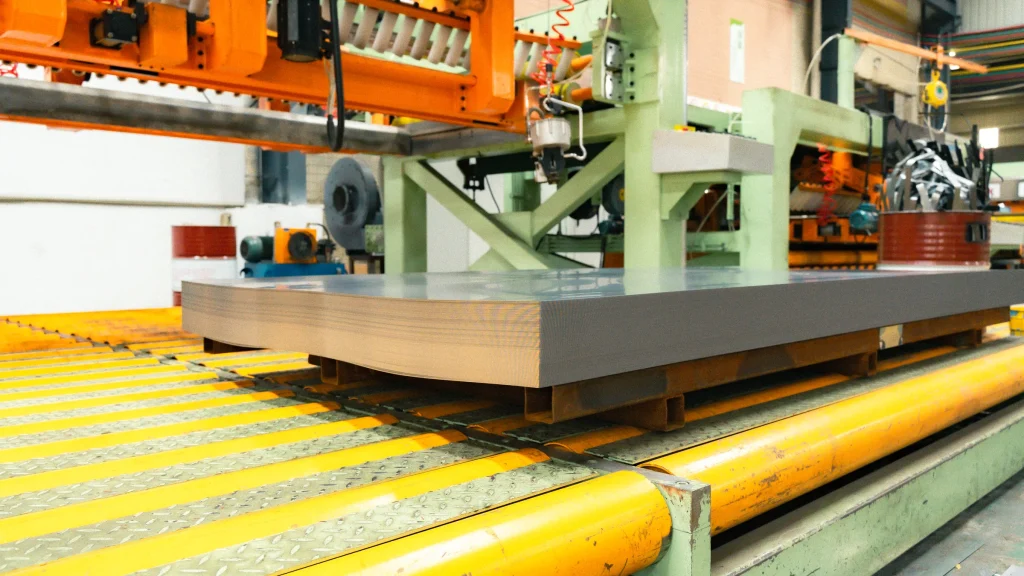
One Part of a Complete Coil-to-Sheet Line
Even a well-built cutting head depends on stable uncoiling, leveling, guiding, length measurement, conveying and stacking. The Flying Shear Cut-to-Length Line overview explains how these sections work together.
Buyers can also compare the 1350mm Flying Shear line or review the 1000mm Dual-Stacking line when sheet handling is a central requirement. If the required output is narrow recoiled strips rather than sheets, see the 1650mm Coil Slitting Line.
Contact RONGXING with your material, thickness, width, coil weight, sheet length and target speed so our engineering team can review the appropriate line configuration.
FAQ
What is special about the RONGXING 1650mm Flying Shear head?
It combines a RONGXING-developed dual-crankshaft cutting head with our own servo motor so the mechanical drive and cutting response can be reviewed as one system.
What material range is shown in this reference configuration?
The component sheet lists 0.4–3.5 mm strip thickness and up to 1600 mm strip width. Final configuration depends on the material and project requirements.
Does ±0.01 mm mean finished-sheet cutting accuracy?
No. It refers to the stated precision of the blade-clearance adjustment mechanism, not final sheet-length or diagonal accuracy.